

When we cast our gaze across the history of economics—navigating from classical political economy to neoclassical math-modeling, and evaluating the core intellectual battles between figures like Adam Smith, John Maynard Keynes, Friedrich Hayek, Milton Friedman, and Ayn Rand—we discover that this science possesses a defining, overarching thread. This hidden driver, or narrative MacGuffin, is the elusive pursuit of a perfect, self-correcting equilibrium between the Map (the accounting, mathematical models, and state counters) and the Territory (the raw human behavior, physical resources, and emergent reality of exchange).
To fully capture how this MacGuffin has propelled economic history forward, we can organize the evolution of economic thought into four distinct, dialectical categories of understanding.
I. The Category of Substance and Value: Labor vs. Subjective Utility
The earliest economic thinkers sought to understand what constituted the actual “substance” of an economy.
• The Classical Foundation: Adam Smith and the classical economists initially grounded the discipline in a literary political economy. They stabilized the map of production by leveraging the Labor Theory of Value, asserting that economic substance was generated by the raw physical sweat and labor hours embedded within commodities.
• The Marginal Revolution: In the late 19th century, a massive structural shift occurred. Economists discarded the Labor Theory of Value and introduced Marginalism. Value was no longer treated as an objective, intrinsic property of an item; it was abstracted into subjective marginal utility.
• The Mathematical Map: This category shift opened the floodgates to pure physics-inspired mathematics in economics. By evaluating the value of going from one unit to the next (e.g., comparing the utility of a first apple to an eleventh), economists could apply continuous-time calculus and optimization equations to human desire.
Here, the MacGuffin reveals itself: by attempting to map human behavior using formulas derived from the physical sciences, economics assumed that human choice operates under a set of unchanging natural laws that apply anywhere, to any society.
II. The Category of Information and Signal: The Central Character of Money
The tension between the map and the territory becomes explicitly operationalized when evaluating how data moves through an economy. In the 20th century, the Great Depression exposed a catastrophic failure of existing models; the institutional business-cycle charts of the 1920s failed to predict or explain the collapse.
• The Keynesian Signal: John Maynard Keynes argued that the Great Depression revealed a fundamental flaw within capitalism itself—that its unmitigated cycles of boom and bust created devastating social instability. The Keynesian solution was to construct macro-models that justified active state intervention, utilizing numbers and fiscal models as a symbol of expert authority in Washington D.C. to balance the economic machine.
• The Monetarist Counter-Mapping: Milton Friedman and Anna Schwartz viewed this through a completely different information lens. For twelve years, they painstakingly built historical charts of “monetary aggregates”—physically tracking how much money was circulating in vaults and wallets. They discovered that the territory didn’t fail because of an inherent flaw in capitalism; rather, the map failed because the Federal Reserve allowed the quantity of circulating money to drop by a third.
Friedman’s Monetarism illustrated that when a state apparatus arbitrarily hits the gas or brake on the money supply, it injects strategic structural noise into the economy, distorting the natural signals of the free market.
III. The Category of Epistemology: Gnostic Planners vs. Agnostic Markets
The history of economics is fundamentally a “game of ideas” split between two philosophical approaches to system design:
1. The Gnostic Approach (The Possession of Hidden Knowledge): Thinkers in this category believe that there is a structural, technocratic truth that can be completely mastered by planners. Historical examples include the Technocracy Movement of the 1930s, where engineers proposed replacing politicians with scientists, abolishing traditional money, and regulating society as a balanced thermodynamic machine using “Energy Certificates”. They trust the mathematical model to completely supersede and control the real-world territory.
2. The Agnostic Approach (The Humility of the Unknowable Market): Conversely, old-school liberals and Austrian economists like Friedrich Hayek and Frank Knight argued against over-mathematizing human action. They posited that society is an evolutionary, historically minded organism. Because human choices are highly distributed and constantly changing, no centralized technocratic map can ever aggregate the vast, chaotic pool of local knowledge accurately.
IV. The Category of Motivation and Existential Identity: The Purist Mythos vs. The Empirical Warrior
The final category structures how economic ideas shape the human psyche and dictate the boundaries of social organization. This dialectic is perfectly captured in the mid-20th-century divergence between Ayn Rand and Milton Friedman.
• Ayn Rand’s Mythopoetic Purism: Rand operated within an axiomatic, first-principles framework. For her, rationality was the absolute defining feature of human existence. Working in a mythic and psychological register, she rejected any dilution of ideas. Her defense of capitalism was strictly moral and philosophical. Rand refused to compromise her map, demanding that the territory adapt to her unyielding standards of individual autonomy.
• Milton Friedman’s Empirical Flex: Friedman, while holding individual freedom as his core value, was deeply empirical. He refined his theories based on historical data and how real people made actual decisions in the world. He was a “half-a-loaf” thinker, willing to accept pragmatic political compromises to move society incrementally toward free-market principles. Near the end of his life, displaying intellectual humility, he even expressed open doubts about how globalization had unfolded, realizing that the real-world territory was straying from his pristine economic expectations.
Conclusion: The MacGuffin Revealed
Whether analyzing the transition from the Global North’s hyperreal financial simulations to the Global South’s unfertilized, high-growth frontier , or reviewing the historical swings between Keynesian intervention and free-market capitalism , the central thread remains an ongoing battle between the Map and the Territory.
The history of economics is driven by this perpetual MacGuffin: the search for an absolute mechanism—be it gold, ergs, monetary policy rules, or mathematical utility optimizations —that can perfectly translate human choice into systemic order. When the categories of the map are treated as rigid, unyielding dogmas, the system inevitably breaks down into technocratic predetermination. Purity of understanding dictates that the map must always serve as an agile, historically conscious reflection of the living territory it seeks to measure.
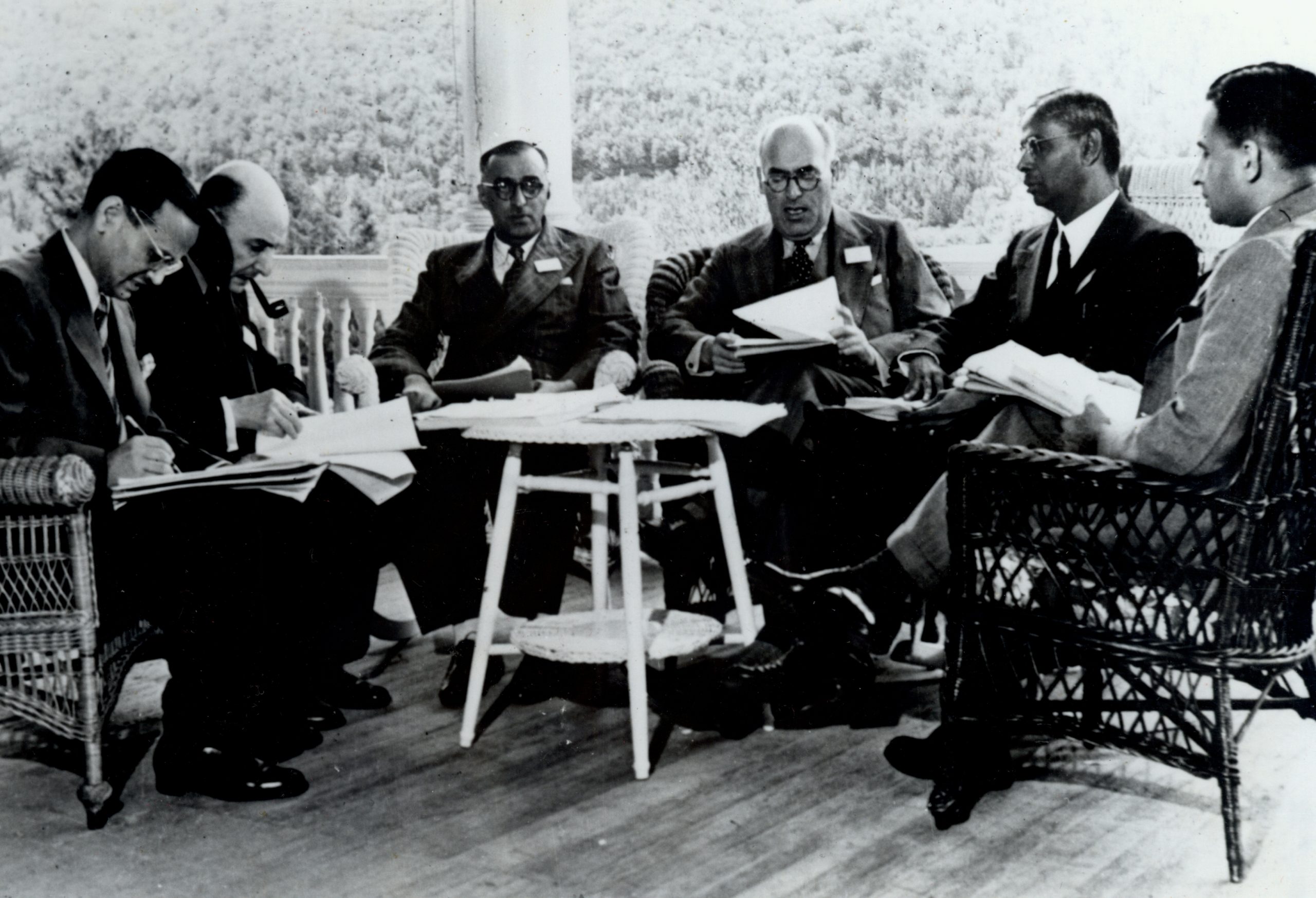 Bretton Woods, N.H., July 5, 1944. (AP Photo/Abe Fox)