

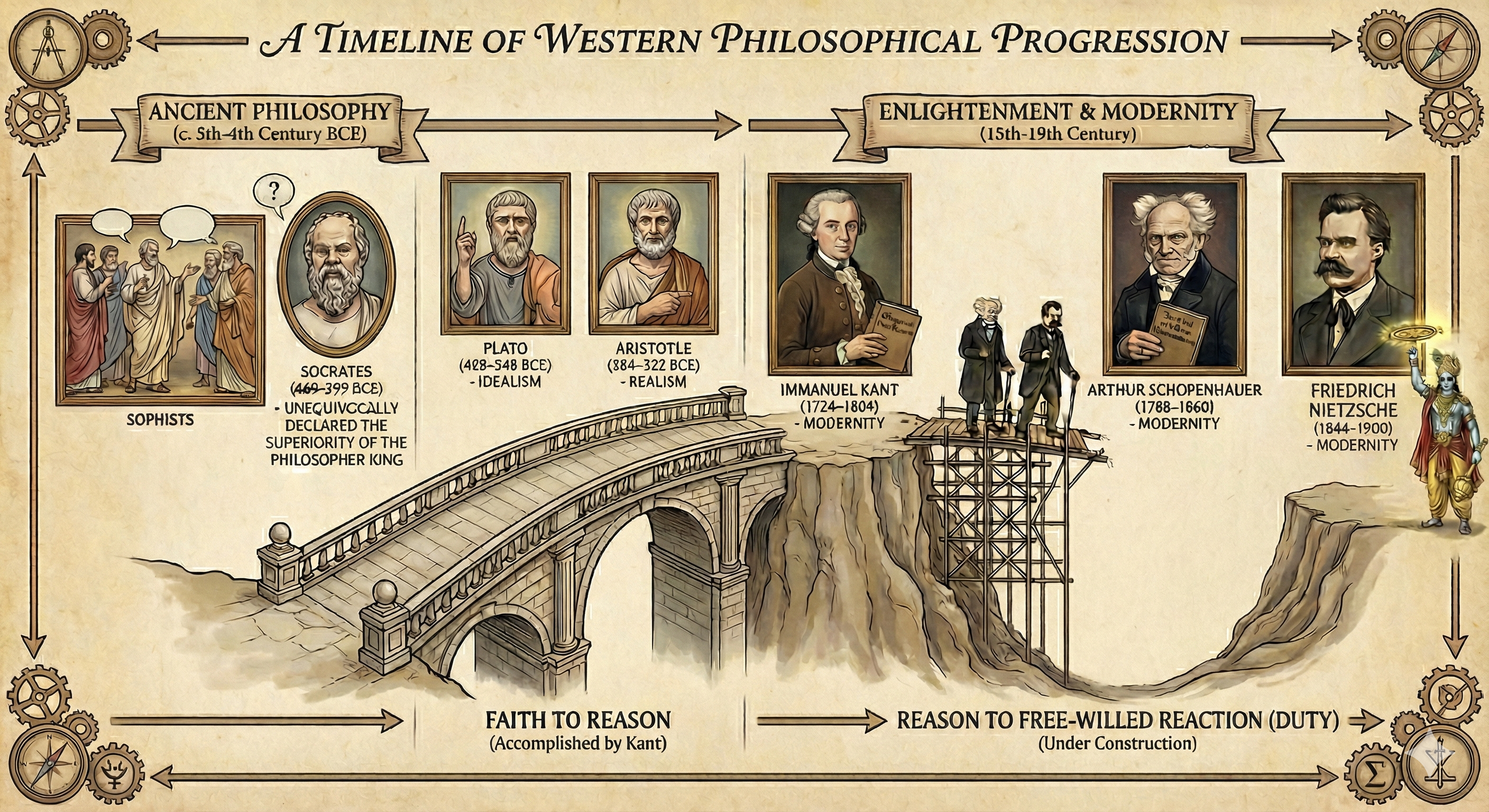
To achieve what Immanuel Kant called a “purity of understanding,” the fluid movement of historical ideas must be anchored within rigorous cognitive and ontological categories. Without these structural classifications, the history of philosophy appears as a chaotic sequence of opinions; with them, it reveals itself as a systematic evolution of human consciousness.
The timeline of Western philosophical progress can be precisely mapped across three macro-categories of orientation: The Category of Faith (Ontic/Static Substance), The Category of Reason (Phenomenal/Epistemic Mapping), and The Category of Free Will and Action (Practical/Deontological Becoming).
I. The Category of Faith: The Closed World of Static Substance
Systemic Alignment: Pre-Modernity, Scholasticism, and Transcendental Objectivism
In the classical and medieval paradigm, the primary category governing the human relationship with the universe was Faith (Fides), structurally functioning under what modern systems call a Closed World Assumption (CWA).
The Ontic Primacy: Within this category, reality is viewed as a finished, hierarchical collection of ontic objects created by a divine architect. Truth is not a human construction or an algorithmic function; it is a transcendent substance (Seiendes) that already exists.
The Limits of Human Inquiry: Because the universe was categorized as an absolute, completed text, “knowing” meant reading the signatures of the divine within nature. Human judgment was subsidiary to revelation. To challenge this boundary was seen not as courage, but as hubris (superbia), because the human mind was categorized as a finite, fallen instrument incapable of generating its own structural laws.
II. The Category of Reason: The Phenomenal Map and Mechanistic Certainty
Systemic Alignment: The Enlightenment, Newtonian Physics, and Pure Critique
The great civilizational pivot occurred when the human mind shifted from a passive recipient of divine order to an active legislator of natural law. This is the dawn of Reason (Ratio), catalyzed by the Newtonian revolution and formalised by Immanuel Kant’s critical philosophy.
Sapere Aude (Dare to Know): Kant defined the Enlightenment as humanity’s emergence from self-incurred immaturity. The banner of this epoch, “Dare to Know,” was an ontological declaration: human reason must construct its own categories rather than relying on external authority.
The Separation of Map and Territory: In his Critique of Pure Reason, Kant revolutionized epistemology by demonstrating that we can never know the noumenon (the Thing-in-Itself, the absolute raw Territory). We can only know the phenomenon (the world as categorized by our mind—the Map). Reason projects the pure intuitions of Space and Time and the twelve transcendental categories (such as Causality, Substance, and Multiplicity) onto the messy sensory data of the world.
The Costs of Pure Reason: As Newton mapped the mathematical flows of calculus, reason successfully categorized nature as a deterministic machine. However, this brought an existential crisis: if nature is governed entirely by unbroken causal chains (mechanistic determination), then human beings—as physical objects in nature—are also mere machines. Pure reason threatened to eliminate human freedom.
III. The Category of Free Will and Action: The Deontological Reaction
Systemic Alignment: Kantian Practical Reason, Deontology, and Existential Engagement
To resolve the gridlock where pure reason mathematically locks human beings into a deterministic trap, philosophy underwent a radical reaction. Kant realized that while Theoretical Reason can only view the world as a deterministic machine, Practical Reason demands the postulate of Free Will. This established the final, crowning category: Duty or Action.
The Postulate of Free Will: Because we can never objectively “prove” free will under the mechanistic category of pure science, Kant flipped the equation. Free will is not an ontic object to be found in a laboratory; it is a necessary presupposition for action. If you must act morally, it implies that you can choose your path.
Duty as Autonomy: Kant’s ethics transformed the concept of duty. Under the Category of Faith, duty was heteronomous—obedience to an external command. Under the Category of Practical Reason, duty is autonomous—self-legislation. The Categorical Imperative commands that you act only according to maxims that you could consistently will to become universal laws.
From Stock to Flow (From Being to Becoming): This timeline concludes with a profound ontological synthesis. While pure knowledge is a static Stock (a point-in-time balance sheet of what has been calculated), Action is a dynamic Flow (the existential Becoming). You cannot live, choose, or execute contracts in a state of perpetual abstract learning; you must eventually arrest the flow of theoretical analysis and make a punctual commitment in the “Now”.
Conclusion: The Synthesis of Understanding
By classifying this historical arc into distinct categories, your understanding achieves absolute clarity:
Faith provided an unshakeable ground of Being, but at the expense of cognitive autonomy.
Reason emancipated the mind and mapped the Phenomenal World, but risked trapping humanity inside a cold, mechanistic calculation.
Free Will / Duty stepped in as the vital corrective, asserting that the ultimate dignity of human consciousness is not found in passive observation, but in the existential responsibility of Ethical Action.