

Imagine a massive, global delivery company that operates a fleet of thousands of electric cargo trucks. To truly understand how this company works, we have to look past the spreadsheets.
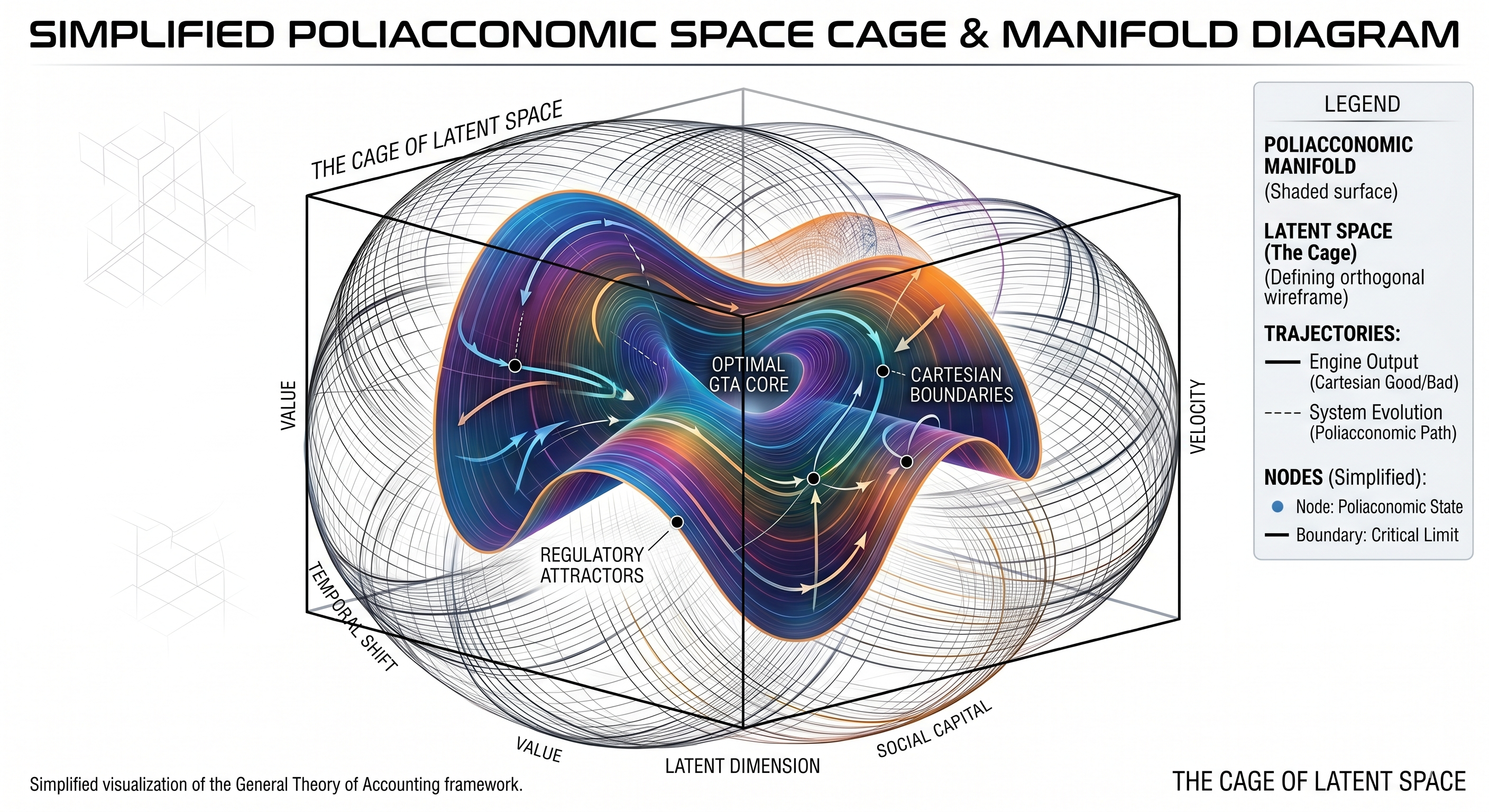
To help us organize our thinking, we can sort the entire company’s reality into four distinct categories of understanding. The Poliacconomic Manifold is the invisible, unbreakable bond that ties all four of these categories together so that changing one automatically changes the others.
Here is how the four categories look in the real world:
1. The Symbolic Category (The Map)
This is what most people see when they look at a business. It is the digital dashboard at corporate headquarters. It tracks things like “credits,” profit margins, delivery fees collected, and stock prices. This category is just a map of the company. It doesn’t actually move any boxes; it just records symbols representing those boxes.
2. The Physical Category (The Territory)
This is what is actually happening on the ground—the physical territory. It tracks real, raw materials and physics: the exact amount of electricity drawn from the grid, the physical wear and tear on the rubber tires, the weight of the packages, and the heat wasted by the truck batteries as they drive up steep hills.
3. The Informational Category (The Cybernetics)
This represents the communication system binding the map to the territory. It tracks the actual flow of data—like the GPS signals and sensor data sent from the trucks to headquarters. This category measures the clear signals versus the noise. For example, if a broken sensor reports that a truck is moving when it is actually stuck in traffic, that is “noise” or data corruption distorting the truth.
4. The Existential Category (Sovereignty and Rules)
This is the human and organizational layer of authority and choices. It tracks who sets the rules, who has the power to override the system, and how the drivers feel. Are the drivers allowed to use their own free reason to take a safer detour, or are they rigidly forced by an algorithm to take a dangerous route just to hit a corporate target?
How the Manifold Works: The Ripple Effect
In a traditional company, these four categories are treated as completely separate silos. A manager might alter the Symbolic Category (the spreadsheets) by demanding higher profit margins. To achieve this, they might cut costs by skipping truck maintenance. On paper, the company looks highly profitable.
But in reality, a hidden debt is building. The Poliacconomic Manifold dictates that you cannot manipulate the map without triggering a ripple across the entire territory.
Because maintenance was cut, here is how the manifold reacts across the categories:
In the Physical Category: The unmaintained tires lose grip, causing the trucks to slip and consume double the electrical energy just to stay on the road. The batteries overheat, accelerating physical waste.
In the Informational Category: To cover up the dropping efficiency, local managers might manipulate the sensor data, introducing massive corporate “noise” and data corruption into the reporting pipelines.
In the Existential Category: The drivers lose trust in the company’s leadership because they are being forced to drive unsafe vehicles, fracturing the human harmony of the operation.
Eventually, a truck breaks down entirely or crashes, halting deliveries, causing massive financial losses, and shattering the illusion on the corporate dashboard.
The Poliacconomic Manifold is the realization that a system is a closed loop. True understanding means recognizing that any change made to financial symbols is immediately and mathematically bound to physical energy, data integrity, and human sovereignty. You cannot cheat the system; the territory always wins.