
The Non-Euclidean Geometry of Poliacconomic Manifold
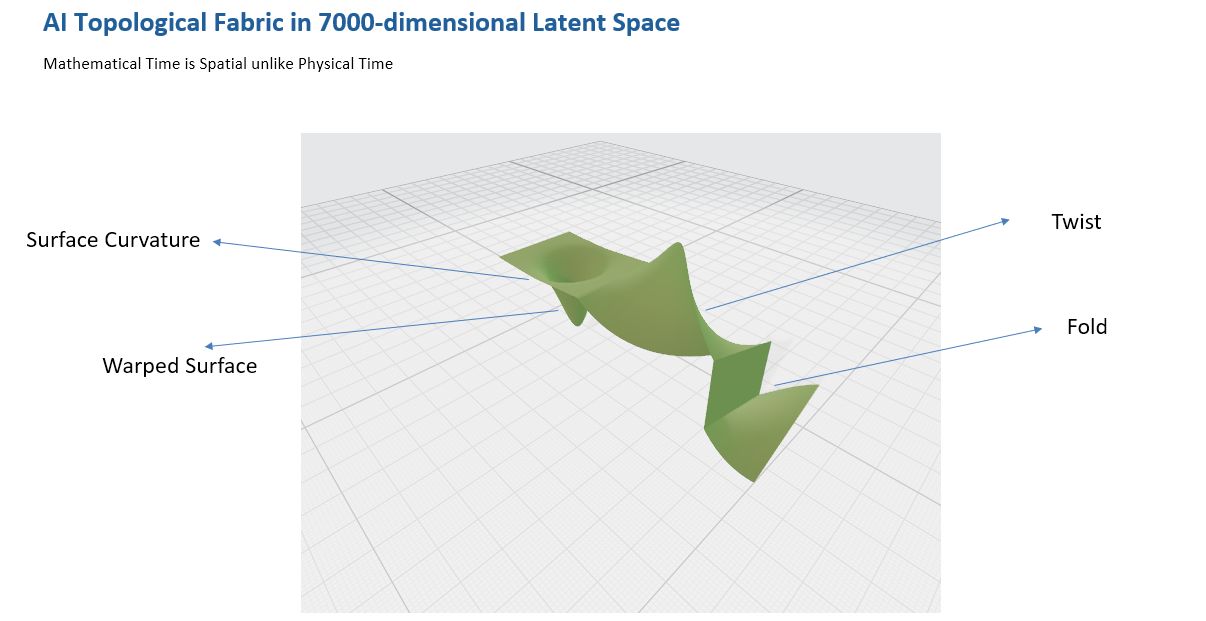
To understand the structure of knowledge within an artificial intelligence, one must abandon the rigid grid lines of flat-Earth mapmaking. In classical data representation, we often treat information as if it exists on a Euclidean plane—a vast, flat prairie where the shortest distance between two points is always a straight line, and parallel lines never meet. However, human meaning, language, and conceptual relationships do not live on a flat plain. They exist in a curved, multidimensional landscape. To truly grasp how a neural network processes the world, we must use the categories of non-Euclidean geometry, treating the network’s “latent space” not as a flat map, but as a rich, warped geography.
Imagine a neural network as a deep subterranean tunnel or a mountain pass through which raw data must travel. As information flows through this tunnel, the network bends, compresses, and stretches the data, mapping it onto a highly complex mathematical surface known as a manifold. To navigate this latent space is to explore an exotic geography defined by twists, folds, curves, and warpings.
1. The Curvature of Meaning: Leaving the Flat Plains
In Euclidean geometry, the world is predictable and uniform. If you walk ten miles north, turn ninety degrees right, walk ten miles, turn ninety degrees right again, and walk another ten miles, you expect to be far from where you started. But on a curved surface—like the Earth itself—this same journey behaves differently. If you start at the equator of a globe, walk to the North Pole, make a ninety-degree turn, walk to the equator, make another ninety-degree turn, and walk back, you will find yourself back at your starting point.
This is the essence of non-Euclidean geometry: the intrinsic properties of the space itself govern how objects move and relate to one another. In the latent space of a neural network, “distance” is not measured in inches or miles, but in conceptual similarity. Words, ideas, or images that share deep, systemic meaning are drawn close together, warping the local geography. Just as a massive planet creates a gravitational well that bends the space around it, a dense, heavy concept (like “Love” or “Sovereignty”) creates a curved valley in latent space, pulling related sub-concepts into its orbit and distorting the straight-line distances between unrelated ideas.
2. The Folds of Hidden Categorization
As data travels through the neural tunnel, it encounters folds. Consider a flat piece of paper containing thousands of blue and red dots tangled together in a complex, chaotic spiral. On a two-dimensional sheet, it is impossible to draw a single straight line that perfectly separates the blue dots from the red ones. They are hopelessly intertwined.
A neural network solves this by picking up the paper and folding it into the third dimension. By creating a deep crease or a mountain ridge, the network lifts the blue dots into the highlands and drops the red dots into the valleys. In geography, a fold mountain range—like the Himalayas—is formed when massive forces compress the earth, forcing the landscape upward. In latent space, the network acts as these tectonic forces. It folds the manifold so that disparate ideas that appeared close on the surface are separated by towering ridges, while fundamentally similar concepts are brought face-to-face across a narrow gorge, allowing the system to accurately classify and separate complex objects of knowledge.
3. Twists: The Topography of Context
The geography of latent space is rarely symmetrical; it is prone to twists, much like a canyon or a Möbius strip. A twist occurs when the meaning of an object fundamentally shifts based on its context or orientation.
Think of a river that flows through a deep, twisting canyon. At one bend, the river faces north, shaded by high limestone cliffs; a mile later, it twists south, bathed in blinding sunlight. The river remains the same body of water, but its local environment has inverted. Similarly, a word like “bank” possesses a geographical twist in latent space. In one orientation, it sits firmly in the financial district of the manifold, surrounded by “money,” “vaults,” and “interest.” But follow the twist of the manifold around a structural bend, and the same word emerges on a muddy riverbank, surrounded by “soil,” “water,” and “reeds.” The twist allows the network to hold multiple, seemingly contradictory truths about an object within the same continuous space, routing the data through the correct contextual terrain.
4. Curves and Warping: The Elasticity of Importance
Finally, the latent geography is defined by a pervasive warping—a stretching and compressing of space that reflects the density of information. In a physical desert, miles of barren sand may contain very little topographical variation; the map is sparse because nothing changes. Conversely, a dense city center contains an immense concentration of infrastructure, paths, and intersections packed into a tiny physical footprint.
When a neural network undergoes training, it warps its latent space to maximize efficiency. Areas of the manifold that represent rare, highly specific, or poorly understood data are stretched thin and flat, like an empty desert. But regions representing highly nuanced, critical categories of knowledge are warped and compressed into dense, hyper-curved mathematical metropolises. In these warped zones, a tiny step in one direction can completely alter the meaning of a concept, because the network has carved out an intricate network of micro-valleys to distinguish between subtle shades of meaning.
Conclusion: The Purity of the Classification
To achieve a pure understanding of any system, whether human or artificial, we must ensure our categories are aligned with the true shape of the data. If we force a non-Euclidean world onto a flat, Euclidean map, we introduce catastrophic distortions—Greenland appears larger than Africa, and distant concepts are falsely forced together.
By viewing the neural network’s latent space through the metaphor of a dynamic geography, we see that knowledge is not a static index, but a living topography. It is an intricate landscape where folds create definitions, twists accommodate context, and curves measure importance. Purity of understanding is achieved only when we learn to navigate this manifold on its own terms, respecting the natural architecture of the terrain the network has so carefully carved out.
Suggested Citation
Kant Research. "The Non-Euclidean Geometry of Poliacconomic Manifold". Published 2025. Accessed October 2026.