
How would Gandhi judge AI?
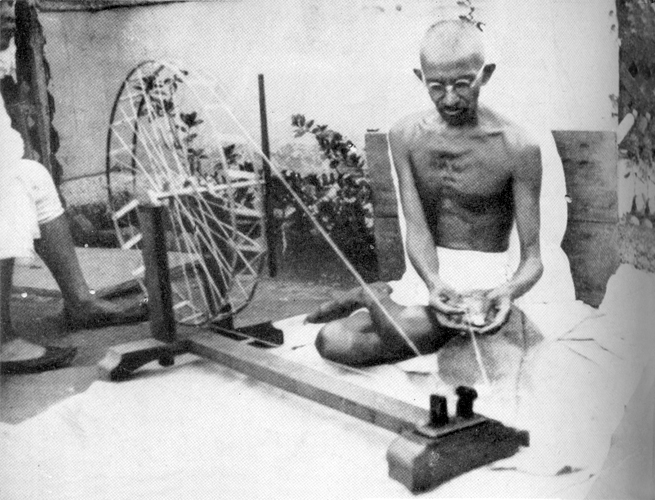
The Digital Spinning Wheel: Is AI a Modern Charkha or Planetary Subjugation?
When Mahatma Gandhi elevated the humble charkha (spinning wheel) into the symbol of Indian independence, he was not merely proposing an economic tool. He was advancing an ontological thesis: that true human freedom (Swaraj) requires a 1-to-1, decentralized relationship between the individual worker and their capital.
Crucially, Gandhi understood that the relationship between capital and human beings can take two opposing forms: it can be rivalrous and competitive (where capital seeks to replace human hands and degrade human dignity), or it can be non-rivalrous and non-competitive (where capital serves as an ally that expands human agency). The charkha was a non-competitive instrument that restored personal dignity, resisted alienating industrial monopolies, and kept technology subservient to the human hand.
In our current era, advocates of artificial intelligence make a striking parallel claim: that AI is the charkha of the mind—a personal, hyper-accessible tool that democratizes cognitive labor and returns creative power to the individual.
However, when interrogated through Martin Heidegger’s philosophy of technology and Gandhi’s economic ethics, this analogy reveals a profound dialectical tension. Is AI truly a non-competitive, “ready-to-hand” instrument of personal liberation, or is it a rivalrous force of planetary subjugation that reduces the essence and substance of the human being?
I. Thesis: AI as the “Ready-to-Hand” Charkha (Zuhandenheit)
To argue that AI fulfills Gandhi’s vision, one must look at how an individual interacts with a personal tool through Heidegger’s concept of Zuhandenheit (Ready-to-handness).
[ GANDHIAN SWARAJ THROUGH ZUHANDENHEIT ]

  Human Hand/Mind  ──►  Tool (Charkha / AI Interface)  ──►  Self-Reliant Creation
  (Sovereign Agent)       (Recedes into Transparency)       (Thread / Software / Thought)
In Being and Time, Heidegger observes that a true tool (like a carpenter’s hammer) is not something we passively stare at (Vorhandenheit / Present-at-hand). When used masterfully, the tool recedes into transparency. The carpenter does not think about the hammer; they think about the house. The tool becomes an extension of the body, serving the user’s immediate care (Sorge) and active agency.
The Arguments for the “AI Charkha”:
- Decentralization of Production: Just as the charkha allowed poor villagers to spin their own cloth without relying on British textile mills, localized AI enables a single individual to write software, analyze data, or generate art without relying on corporate bureaucracies.
- 1-to-1 Symbiosis: The user sits directly before the interface. The AI responds instantly to human intent, acting as a cognitive bicycle that amplifies human thought without replacing human direction.
- Restoration of the Artisan: AI lowers the barrier to entry for complex intellectual crafts, transforming passive consumers into active creators (Swaraj of the mind).
- The Non-Rival Capital Partnership: Unlike physical factory machinery—which is rivalrous because one machine replaces ten workers—digital compute can be endlessly multiplied. In this view, AI functions as a non-competitive super-agency: a tool that does not compete with the human worker for employment or dignity, but sits alongside them to elevate their creative substance.
From this perspective, AI functions as a modern charkha: an individualized, non-rival, ready-to-hand instrument that preserves human agency through a direct 1-to-1 partnership between human intellect and compute capital.
II. Antithesis: AI as the Universal Enframing (Ge-stell)
Despite the appeal of this vision, applying Heidegger’s later essay, The Question Concerning Technology, alongside Gandhi’s critique of machinery, exposes the charkha analogy as a dangerous Category Error.
The charkha is an innocent piece of equipment (Zeug). Modern AI, however, is not a discrete tool; it is the ultimate expression of Ge-stell (Enframing).
                  [ THE CHASM BETWEEN CHARKHA AND AI ]

  DIMENSION            THE GANDHIAN CHARKHA           HYPERSCALE AI
  -----------------------------------------------------------------------------
  Ontological Mode     Zuhandenheit (Tool)           Ge-stell (Enframing)
  Physical Nature      Transparent, local, wooden    Opaque, hyper-centralized clouds
  Human Status         Sovereign Master/Artisan      Bestand (Data to be harvested)
  Capital Scale        Micro-capital (Individual)    Monopolistic Mega-capital
  Capital Relation     Non-rival & Non-competitive   Rivalrous & Substitutive in Essence
Why the Charkha Analogy Breaks Down:
-
The Conversion of Human Cognition into Bestand (Standing-Reserve):
Under Ge-stell, technology is not a tool we use; it is an overarching system that forces all of nature and humanity into raw resource material (Bestand) to be extracted, processed, and optimized. When an individual spins cotton on a charkha, they own the cotton and the wheel. When an individual prompts a cloud-hosted AI, their thoughts, prompts, and linguistic patterns are harvested to train the central model. The user is not the artisan; the user is the raw material being processed by central capital. -
Mechanical Transparency vs. Algorithmic Opacity:
The charkha is mechanically transparent. Anyone can inspect its wood, string, and wheel, understand its workings, and repair it locally. AI is an opaque, multi-billion-parameter “black box.” The user has zero visibility into how the neural network transforms inputs to outputs. A tool you cannot understand or repair is not a tool that gives you sovereignty; it is a system on which you are dependent. -
Hyper-Centralization of Capital:
The charkha was explicitly designed to destroy central monopolies by distributing production to millions of homes. Modern AI relies on extreme concentrations of capital: mega-data centers, massive energy grids, semiconductor monopolies, and proprietary datasets. Using a terminal interface connected to a multi-billion-dollar corporate server is the exact opposite of Gandhian self-reliance—it is total technological dependency. -
Essence-Level Rivalry: Capital in Direct Competition with Human Substance:
Gandhi championed a non-competitive relation between capital and labor because he saw that industrial machinery, in its essence and substance, is inherently rivalrous. Industrial capital does not seek to partner with the worker; it seeks to eliminate the worker’s labor, undercut their livelihood, and reduce them to an auxiliary attendant. Modern corporate AI takes this rivalry to its ultimate conclusion: it enters into direct competition with human consciousness itself. It aims to automate art, writing, reasoning, and judgment. Rather than preserving human agency, it threatens to render human cognitive substance obsolete.
III. Synthesis: The Illusion of Interface (Micro-Zuhandenheit serving Macro-Ge-stell)
How do we resolve this contradiction? How can a technology feel like a personal spinning wheel while structurally acting like an industrial leviathan?
The dialectical synthesis reveals that AI operates on two split levels simultaneously:
[ THE AI DIALECTIC ]

  MICRO-LEVEL (The Interface)   ──►  Appears as Zuhandenheit (Personal Charkha)
                                     Seduces the user with a sense of local agency
                                     and non-competitive super-agency.
                                       │
                                       ▼
  MACRO-LEVEL (The Infrastructure) ──►  Functions as Ge-stell (Enframing)
                                     Acts as a rivalrous capital force that absorbs
                                     and replaces human cognitive substance.
Gandhi’s Verdict: How Would He Judge AI?
If Gandhi were to evaluate current cloud-hosted, monopolistic AI, he would decisively judge it NOT as a non-competitive charkha, but as a rivalrous, competitive force that degrades human essence.
He would observe that while the chat interface pretends to be a non-rival assistant, the underlying capital structure is built to compete with human creators, replace human labor, and centralize power in the hands of a few tech oligarchs. It treats the human mind as raw material to be harvested, eroding the self-reliance (Swaraj) of the individual.
The Outcome of the Proposition:
-
The Charkha Analogy is a Seductive Myth:
Calling corporate, cloud-hosted AI a “modern charkha” is a false analogy. It mistakes the convenience of the user interface for structural human agency. The interface gives you the sensation of using a non-rival tool, while the underlying infrastructure binds you to an unprecedented system of central extraction and competitive replacement. -
The Condition for Genuine Digital Swaraj:
If AI is ever to become a true charkha that preserves human agency and establishes a genuinely non-rival relationship between capital and humanity, it must break free from corporate Enframing. For an AI to be a non-competitive instrument of liberation, it must fulfill four strict Gandhian/Heideggerian conditions:- Local Sovereignty: The AI must run entirely on local, user-owned hardware (small, open-weight models), severing the umbilical cord to corporate clouds.
- Algorithmic Transparency: The data inputs, weights, and alignment rules must be fully open and inspectable by the user.
- Non-Extractively Bound: The user’s interaction must not be harvested to feed a central capital engine.
- Non-Rivalrous Intent: The system must be designed as a local cognitive amplifier that enhances human skill and craft rather than a centralized replacement engine that renders human labor redundant.
Conclusion: The Choice Before Us
Gandhi did not reject machinery because he hated progress; he rejected machinery that reduced human beings to passive cogs in a distant factory.
If we consume AI as a black-box service owned by planetary tech monopolies, we are not spinning our own thread. We are feeding the mill. We become dependent subjects operating under the illusion of individual choice, engaging with a capital force that is fundamentally rivalrous to our own human substance.
Only when AI is radicalized into open, local, non-competitive, and sovereign compute does it shed the trap of Ge-stell and approach the spirit of the charkha. Until then, the true Heideggerian response to cloud-hosted AI must be Gelassenheit (releasement / standing back)—refusing to let our inner cognitive worlds be enframed, harvested, and replaced by the wire.
Suggested Citation
Kant Research. "How would Gandhi judge AI?". Published 2026. Accessed October 2026.