
Why World Leaders should take Dimensional Reduction lessons from Putin?
The Mechanics of Subtraction: Dimensional Reduction and Coherence in Executive Governance
An India exemplar could help position this dilemma, Gandhi had a small brain. Nehru had a large brain. Which one was more effective and what should one aspire to develop or cultivate? To ask whether one should maintain a “large brain” (a dimensional surplus) or a “small brain” (a dimensional reduction) to reach reality is to ask a fundamental question: Does truth yield to hyper-capacity and aggregation and accumulation, or does it yield to subtraction?
Group decision-making bodies—whether corporate boards, military staffs, or national security councils—frequently suffer from a paralysis of high dimensionality. When senior officials gather to deliberate a critical decision, each participant enters the room carrying a complex, subjective “mind-dependent map.” These maps are dense with institutional self-interest, personal risk aversion, diplomatic hedging, and speculative scenarios.
When a decision-making body operates in a state of high dimensional surplus, conversation turns into endless debate, responsibility diffuses, and action becomes impossible.
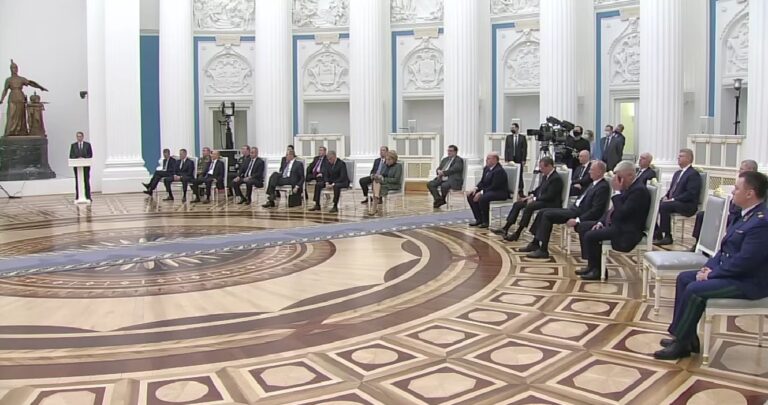
To achieve absolute coherence, an executive leader must act as a dimensional reduction operator. The televised meeting of the Russian Security Council on February 21, 2022—held two days before the launch of the Special Military Operation in Ukraine—offers a dramatic, textbook illustration of how a leader can systematically subtract surplus variables, collapse subjective maps, and force a group toward a single, coherent consensus.
I. The Anatomy of High-Dimensional Paralysis
Prior to the February 21 meeting, the Russian national security apparatus possessed a chaotic, multi-variable decision space. Different council members viewed the crisis through competing institutional lenses:
- The Diplomatic Map (Foreign Ministry): Focused on international negotiations, the preservation of the Minsk agreements, and managing relations with Western powers.
- The Intelligence Map (SVR/FSB): Focused on covert influence, long-term subversion, and calculated risk assessments.
- The Economic Map (Finance/Cabinet): Focused on sanction exposure, energy markets, and financial insulation.
- The Military Map (Defense Ministry): Focused on force projection, troop positioning, and operational readiness.
Left unmanaged, these competing maps create high-dimensional friction. Every participant hedges their language to protect their institution, leaving room for retreat if the policy fails. The result is ambiguous groupthink, where everyone agrees in principle but no one commits to a concrete reality.
[ HIGH-DIMENSIONAL NOISE ]
(Diplomatic Hedging + Economic Fear + Intelligence Speculation + Bureaucratic Self-Protection)
                                   │
                                   ▼  [ Executive Subtraction Operator ]
[ DIMENSIONALLY REDUCED CONSENSUS ]
(A Single, Binary Operational Reality)
II. The Catherine Hall Meeting: Subtraction in Public View
The physical and procedural setup of the Security Council meeting in St. Catherine’s Hall was explicitly engineered to strip away subjective noise. Vladimir Putin sat alone at a central desk, separated by vast physical space from the council members seated in a semicircle.
The televised broadcast was not merely a public relations exercise; it was an algorithmic tool of subtraction. By forcing the deliberation onto live television, private caveats and off-the-record hedging were rendered impossible.
               [ THE METHODOLOGY OF EXECUTIVE SUBTRACTION ]

  1. ISOLATION              2. INTERROGATION            3. BINARY REDUCTION
  Remove private channels   Challenge procedural        Force individual commitment
  and bureaucratic cover.   hedging in real time.       to a single, clear axis.
1. Stripping Away Procedural Hedging
As council members were called to the podium one by one—including Foreign Minister Sergey Lavrov, Defense Minister Sergey Shoigu, and Security Council Deputy Chairman Dmitry Medvedev—Putin systematically redirected their statements away from abstract background analysis toward a single, immediate question: Should Russia recognize the independence of the Donetsk and Luhansk People’s Republics?
When participants attempted to introduce surplus dimensions—such as giving Western diplomacy one more chance or negotiating further—they were brought back to the primary axis. The goal was to eliminate “time” and “further talk” as available variables.
2. The Naryshkin Exchange: The Collapse of the Subjective Map
The most defining moment of dimensional reduction occurred during the interrogation of Foreign Intelligence Service (SVR) director Sergey Naryshkin.
When Naryshkin attempted to hedge his position by speaking vaguely about “giving Western partners a last chance” and then stumbled into saying, “I will support the proposal to incorporate…” Putin immediately intervened to strip away the ambiguity:
“We are not talking about incorporating them into Russia. We are talking about whether to recognize their independence or not. Speak clearly! Do you support recognition, or not?”
By publicly correcting Naryshkin, Putin performed an act of forced dimensionality reduction. He eliminated:
- The variable of territorial annexation (which was not on the table that day).
- The variable of conditional future support.
- The variable of diplomatic delay.
Naryshkin was forced to discard his complex, protective intelligence script and reduce his position to a single, unequivocal “Yes.” One by one, every key member of the state apparatus was made to step to the microphone and state their alignment without qualification.
III. Governance Lessons: Achieving Group Coherence Through Subtraction
| Dimension of Decision | High-Dimensional Deliberation (Typical Board) | Reduced-Dimensional Execution (The Kremlin Model) |
|---|---|---|
| Language | Conditional, abstract, full of caveats. | Declarative, simple, binary choices. |
| Individual Strategy | Protect personal/institutional reputation. | Public, irreversible commitment to the group decision. |
| Role of the Leader | Passive referee collecting opinions. | Active operator subtracting non-essential variables. |
| Outcome | Compromise solutions that satisfy no one. | Absolute, operational alignment around a single path. |
By subtracting the “surplus dimensions” of institutional self-protection and diplomatic speculation, the executive reduced the high-dimensional mental maps of the participants to a single, shared reality. The entire national security elite was bound to the exact same decision, making subsequent dissent structurally impossible.
IV. The Dialectical Challenge: The Risk of Over-Reduction
For a dialectic, we must test this governance model against its ultimate limitation: Does aggressive dimensional reduction reveal objective reality, or does it construct a dangerous blind spot?
               [ THE DIALECTICAL TENSION OF REDUCTION ]

     ADVANTAGE: ABSOLUTE COHERENCE         RISK: SYSTEMIC BLINDNESS
     • Eliminates internal friction.       • Deletes real-world variables.
     • Creates unstoppable momentum.       • Mistakes forced agreement for truth.
     • Guarantees total alignment.         • Vulnerable to unmodelled reality.
While dimensional reduction succeeds in creating perfect internal coherence, it carries an existential governance risk:
- The Confusion of Alignment with Truth: Stripping away the “surplus dimensions” of council members stops internal debate, but it does not alter mind-independent reality. If an adviser’s “hedging” is based on real-world constraints—such as economic vulnerabilities, military logistics, or foreign resistance—subtracting those warnings from the conversation does not remove them from the battlefield.
- The Hazard of Over-Simplification: When a leader forces a high-dimensional world into a simple binary choice, the decision-making body becomes highly decisive, but fragile. If the simplified model omits critical real-world variables, the group moves forward with absolute coherence directly into a unforeseen wall of complexity.
V. Conclusion
The televised Security Council meeting of February 21, 2022, remains a masterclass in executive power and cognitive reduction. It demonstrates that true alignment in a decision-making body is rarely achieved by adding more information or building consensus through endless compromise. It is achieved through subtraction—by cutting away procedural noise, forcing individuals out of their protective abstractions, and reducing complex subjective maps down to a single, unavoidable point of action.
For any leader, the lesson is clear: Coherence requires reduction. However, the ultimate test of governance is ensuring that in subtracting the noise of the room, you do not accidentally strip away the real-world facts necessary for survival.
Suggested Citation
Kant Research. "Why World Leaders should take Dimensional Reduction lessons from Putin?". Published 2026. Accessed October 2026.